
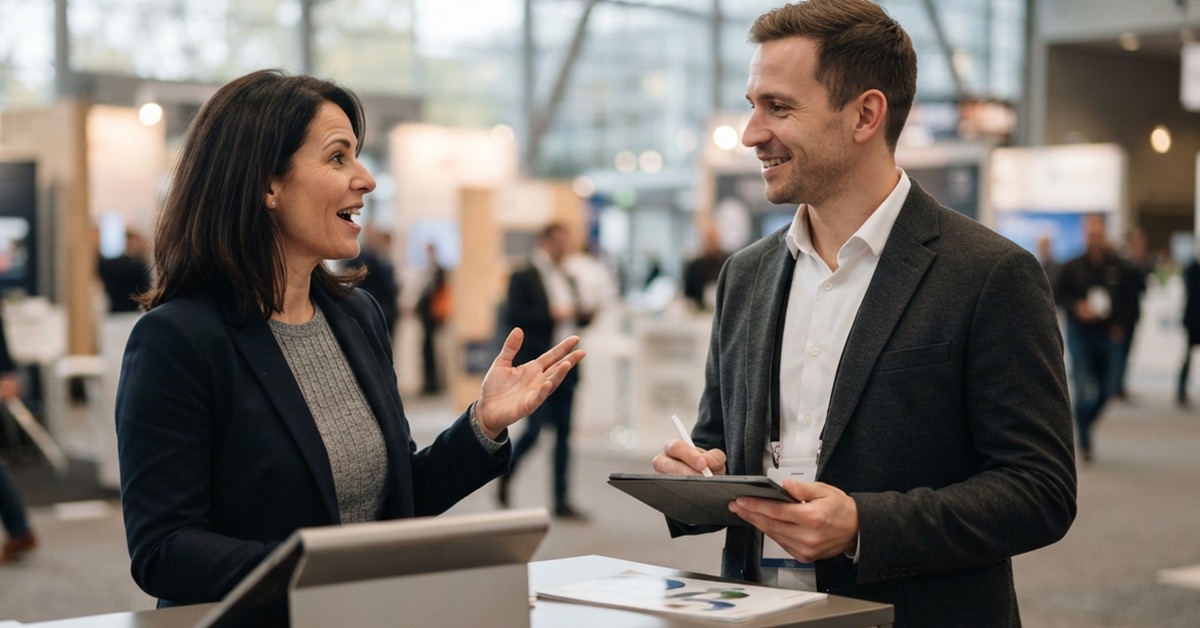
Trade shows still generate the highest-intent B2B leads a Benelux company can buy, ahead of paid search, email, and social media combined. Belgium alone lists close to 780 exhibitions a year, and 72% of attendees say they are more likely to buy from a company they met on the show floor (Cvent, 2025).
What a trade show actually does for B2B visibility
A trade show is a scheduled, in-person event where companies in a shared industry exhibit products, meet buyers face to face, and generate press coverage in a compressed window of time. For B2B visibility specifically, a trade show works as three channels running at once: a sales channel through live demonstrations, a media channel through journalists and analysts walking the floor, and a content channel through footage, quotes and data a company can reuse for months afterward. That compounding effect is why 72% of trade show attendees say they are more likely to buy from an exhibitor they met in person, according to Cvent’s 2025 trade show research. Digital channels can target an audience with precision, but they cannot replicate a buyer physically testing a product, a journalist filming a demo, or a CEO answering a hard question in real time. In the Benelux, where B2B networks are small and reputations travel fast, that in-person layer still decides who gets remembered.
Why buyers still trust the show floor over digital channels
B2B buyers do not wander onto a show floor by accident. Cvent’s 2025 research on trade show behavior found that 68% of attendees already know which stands they plan to visit before the doors open, built from pre-show marketing, sponsor emails and social previews. The floor visit itself is the final step in a buying decision that started weeks earlier online.
Median exhibitor spend per show has risen to $32,400 in 2025, a 14% increase from 2022, as companies invest in fewer, higher-impact shows rather than a full calendar of smaller ones. A booth that repeats a website’s homepage message wastes the one moment a buyer has already pre-qualified themselves to listen. For a Benelux exhibitor planning next year’s floor space, that shift means fewer, sharper appearances beat a packed conference calendar.
This is not just a Benelux pattern. Forrester’s Q1 2025 State of B2B Events survey found that 59% of event decision-makers are shifting budget toward smaller, more targeted hosted events instead of large generic booths, because a focused room converts better than a crowded aisle.
Backstage sees the same pattern working press days for Benelux manufacturing and life sciences clients. A journalist who has already read the press release wants fifteen minutes with the product engineer, not a repeat of the slide deck. The stand’s job is to deliver the conversation the website could not.
That effect is sharper in a market the size of the Benelux. A Dutch, Belgian or Luxembourg buyer often already knows a competitor’s account manager by name, so the trade show floor is less about first impressions and more about confirming a company still shows up in person. Skipping the regional flagship show for two years running gets noticed faster in a market this size than it would in Germany or France.
What the Benelux exhibition market looks like right now
Digital ad spend can be paused with one click. A trade show calendar cannot, because competitors, distributors and trade press already treat it as fixed infrastructure for the year. Skipping a slot on that calendar does not free up budget quietly, it hands a competitor an empty stand’s worth of attention.
The Benelux is not shrinking as a trade show market, even as marketing budgets move online. UFI’s Global Exhibition Barometer, published in February 2025 from a survey of 390 companies across 56 countries, found global exhibition revenues grew 16% in 2024 and forecast a further 18% growth in 2025. Belgium alone lists 779 expos, trade fairs and exhibitions, with 158 more scheduled for 2026 and 2027, according to event directory 10Times. Brussels Expo, at 115,000 square metres, remains the largest exhibition venue in the Benelux and anchors flagship events such as Batibouw and the Brussels Motor Show. For a Benelux B2B company, that density means competitors are already booking floor space and press slots on the same calendar. Staying absent from that calendar is not neutral. It is a visible gap a competitor’s sales team will happily point out to a shared prospect.
The mix of venues also explains why international exhibitors keep booking Benelux stands even when their home market is larger. Brussels sits next to the EU institutions that set the regulations many exhibitors are trying to influence, and Antwerp anchors one of Europe’s largest ports, which pulls in logistics and chemical buyers who would otherwise never see a Belgian trade press outlet.
The regional venues carry different weight depending on sector:
| Venue | City | Known for |
|---|---|---|
| Brussels Expo | Brussels | Belgium’s largest exhibition space at 115,000 m², home to Batibouw and the Brussels Motor Show |
| Flanders Expo | Ghent | Regional trade and consumer fairs serving Flanders |
| Antwerp Expo | Antwerp | Port-adjacent trade shows in logistics, chemicals and maritime industries |
| Namur Expo | Namur | Wallonia’s agricultural and regional B2B events |
None of these venues generate visibility on their own. A stand at Brussels Expo gets the same passive foot traffic whether or not a company briefed a single journalist beforehand. What decides whether that traffic turns into coverage is the plan built around the stand, not the square metres it occupies.
How PR turns a trade show stand into lasting visibility
A stand generates visibility for exactly as many days as the show runs, unless PR extends it. Backstage treats a Benelux trade show as a five-step press campaign, not a single event day, because the show floor is only the midpoint of the story, not the whole of it.
- Pitch the story six to eight weeks out. Trade press plan their show coverage in advance, and a generic product announcement competes with dozens of others unless it carries a specific, newsworthy angle tied to the show’s theme.
- Brief the spokesperson before the doors open. A stand only works as a media channel if whoever is standing on it can answer a hard question without checking with head office, which is why media training before the show floor opens matters more than the booth design itself.
- Book analyst time on-site. Industry analysts walk Benelux trade shows specifically to update their vendor comparisons, and analyst relations shapes which vendors get named in the reports buyers read months after the show closes.
- Put a named executive in front of the press, not a logo. CEO positioning built through consistent PR gives journalists someone to quote directly, instead of a press release nobody remembers by the following week.
- Repurpose the floor footage for six months afterward. Photos, quotes and product demos captured during the show become the raw material for the kind of corporate storytelling that a stand alone cannot deliver once the hall lights go off and the crowd has gone home.
None of these five steps need a bigger budget than the exhibitor fee itself. They need a plan written before the stand is built, not scrambled together after the show closes and the leads have already gone cold. Most Benelux exhibitors already have a marketing budget for the stand itself. What is usually missing is the six weeks of press groundwork before the hall opens, which costs time and coordination rather than a bigger line item.
Questions Benelux marketers ask before exhibiting
Are trade shows still worth the budget in a digital-first market
Yes, but only for exhibitors who use the floor for conversations digital channels cannot replicate. Cvent’s 2025 research found 72% of attendees are more likely to buy from an exhibitor they met in person, a number no banner ad or LinkedIn post matches on its own. The real budget question is not whether to attend, it is whether the stand is built to earn press coverage or just collect scanned badges.
How do you measure trade show ROI beyond leads collected
Leads counted at the booth undercount the real return on a trade show. A complete picture tracks earned media placements, analyst mentions and content pieces produced from the show, alongside sales-qualified leads three months later, once the follow-up calls have actually happened. Backstage builds trade show performance into the same PR measurement framework used for other Benelux campaigns, so a show gets judged on the same terms as any other channel, not treated as a one-off cost.
Should a Benelux SME exhibit internationally or stay local first
Most Benelux SMEs get more from dominating one regional show before booking a stand at a larger international fair abroad. Local trade press and analysts already cover the domestic circuit closely, so a strong, well-briefed showing at Brussels Expo or Flanders Expo builds the citable coverage and case studies that make an international budget easier to justify a year later. Going abroad first, before that home coverage exists, usually means paying for a much bigger stand with none of the press relationships that made the domestic show worth attending.
What is the difference between trade show marketing and trade show PR
Trade show marketing fills the stand with visitors and captures leads at the door. Trade show PR turns the same three days into press coverage, analyst mentions and executive visibility that outlives the event by months. Most Benelux exhibitors budget heavily for the first and barely plan the second.
What happens after the stand comes down
A trade show stand pays for itself only if the visibility it generates outlasts the event itself. The exhibitors who see the strongest return are rarely the ones with the biggest booth, they are the ones who briefed a journalist six weeks out, put a trained spokesperson in front of the press, and turned the floor into six months of content afterward. That preparation is what converts the 72% of attendees who say they are more likely to buy from an exhibitor they met in person into an actual signed deal, not just a scanned badge. For a Benelux company, the show floor is still where competitors, analysts and trade press physically meet in one room. Treating that room as a PR opportunity, not just a sales stand, is what decides who gets remembered after the doors close.
- Brief trade and analyst press six to eight weeks before the show, not the week of.
- Train whoever staffs the stand to answer a hard question without checking with head office.
- Put a named executive in front of journalists instead of a logo.
- Capture photo, video and quotes on-site to fund six months of content afterward.
- Measure earned coverage and analyst mentions alongside leads, not instead of them.
Backstage helps Benelux B2B companies turn a trade show stand into a press campaign, not just a lead list. If a show is already on the calendar, the six-week window before it opens is when that plan needs to start.