
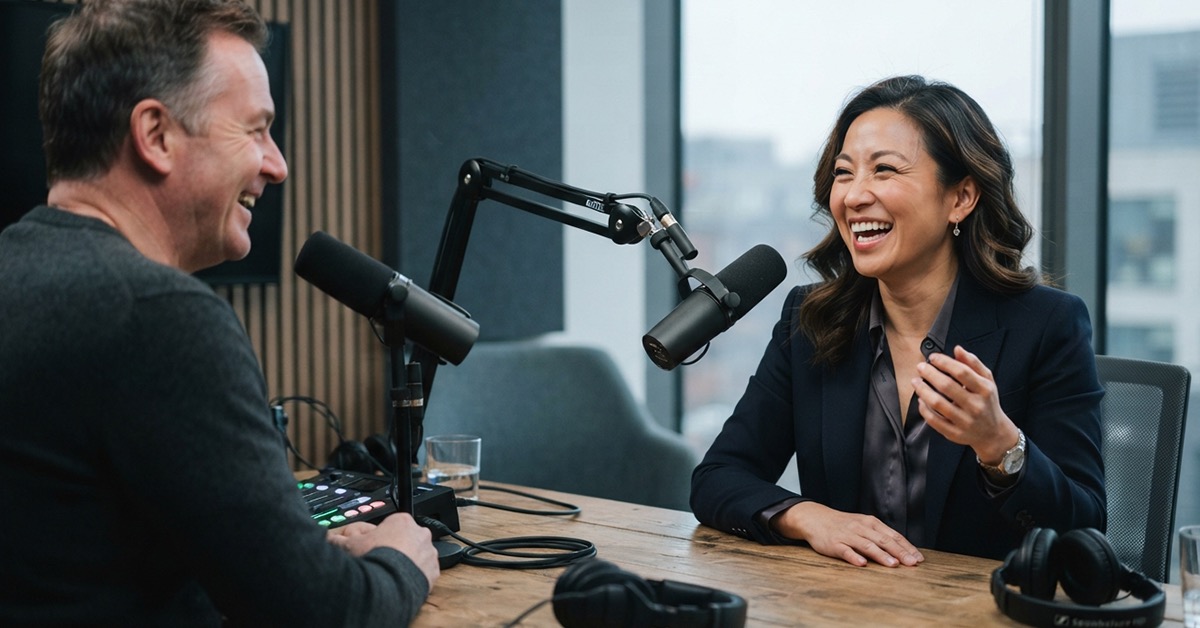
Podcast guesting turns a single 45-minute conversation into a backlink, an AI-citable transcript, and a direct line to a niche buyer audience, three assets a press release rarely produces. For B2B executives building authority in a specific market, that combination now outperforms most owned content per hour invested, and Belgian industry podcasts have multiplied fast enough to make guesting a realistic monthly habit rather than a quarterly stretch goal.
What podcast guesting is
Podcast guesting is the practice of a company leader appearing as an invited guest on an existing industry podcast to answer questions and share expertise, rather than building and hosting a show from scratch. It differs from a traditional media interview because the format runs 30 to 60 minutes, long enough for an executive to demonstrate reasoning instead of delivering a single soundbite. The Edelman-LinkedIn B2B Thought Leadership Impact Report (2024) found that 75% of B2B decision-makers say thought leadership content, including podcast appearances, directly shapes which vendors make their shortlist.
Each guest appearance produces three durable assets: a backlink from the show’s website, a transcript that search engines and AI answer engines can index and quote, and access to an audience the host already spent months building. That combination is why podcast guesting now sits inside most B2B authority plans as a repeatable channel, not a one-off favor to a host.
Why podcast appearances build authority faster than articles
Articles earn attention through search rankings, which take months to build and compete against thousands of similar posts. Podcast guesting works differently, because the host’s existing audience already trusts the show, and that trust transfers to the guest the moment they speak. Executives get asked follow-up questions live, a format where a confident answer carries more weight than a polished paragraph.
IAB Europe’s 2025 podcast advertising report put European podcast ad spend at over 500 million euros, up 22% year on year, a growth rate publishers chase only inside formats listeners genuinely stay subscribed to. Cision’s Global State of the Media Report (2025) found that 41% of journalists now use podcasts as a primary research source when building stories on a sector, which means a strong guest appearance can trigger press coverage the executive never pitched directly.
HubSpot’s 2025 State of Marketing report found that B2B marketers ranked podcasts as the content format delivering the highest return relative to production cost, ahead of long-form video and webinars. That ranking reflects a simple production reality: a guest appearance requires no script, no studio booking, and no editing budget from the executive’s side, since the host’s team handles recording and distribution.
One Belgian logistics-sector client of Backstage secured five podcast guest slots in a single quarter and generated more qualified inbound requests from those episodes than from its two previous press releases combined. The lesson is not that press releases stopped working, but that a 45-minute conversation format now out-produces a 400-word announcement for building a specific kind of trust, the kind that depends on hearing someone reason through a hard question in real time.
How AI search engines treat podcast transcripts as citable sources
AI answer engines such as Google’s AI Overviews, ChatGPT, and Perplexity need text they can quote with confidence, and a podcast transcript is often more quotable than a brand’s own website copy, because it reads as a real person answering a real question. Princeton’s 2024 GEO research found that content embedding specific, verifiable statistics gets cited by AI systems 37% more often than content making vague claims, and a guest appearance naturally produces that structure, because a good host asks for numbers.
Most podcast platforms now auto-publish a full transcript alongside the audio file, and that transcript gets indexed independently of the show’s homepage. A transcript where an executive states a concrete figure, names a source, and explains the implication reads to an AI retrieval system exactly like the citation clusters search engines reward in written content. This is also why AI-powered search is changing B2B discoverability in Belgium faster than most marketing teams have adjusted for.
This matters for entity recognition specifically. When an executive’s name appears next to a consistent job title and company across multiple independently published transcripts, AI systems build more confidence attributing expertise to that person, similar to how structured data on a company’s own site reinforces the same entity. A single podcast appearance rarely shifts this on its own, but a steady cadence across a year builds a recognizable footprint the way a single article never does.
How to choose which podcasts are worth an executive’s time
Not every podcast invitation deserves a yes, and chasing volume over fit wastes an executive’s limited calendar. Four criteria separate a worthwhile guest slot from a vanity booking.
- Audience match over download count. A show with 800 regular listeners in exactly the right logistics or fintech niche outperforms a general business podcast with 20,000 downloads and no buyer overlap.
- Host credibility and interview style. Listen to two full episodes before accepting. A host who interrupts, rushes past numbers, or never lets guests finish a thought will flatten even a strong answer.
- Publishing consistency. A show that has published weekly for over a year signals an engaged subscriber base; a show with gaps of several months between episodes rarely has one.
- Transcript and show notes quality. Shows that publish full transcripts and detailed show notes give AI systems and search engines something to index, while audio-only shows with a one-line description give almost nothing back.
Timing matters as much as fit. A show that recorded its most relevant episode on a topic eight months ago is a worse booking than a newer show actively building a season around that theme, since algorithmic and AI discovery both favor recency alongside relevance. Executives who wait for the single most prestigious name in a category often miss a shorter window where a specific topic is actively being searched, which matters more for discoverability than prestige alone.
Backstage typically vets 15 to 20 shows per sector before recommending a shortlist of five to a client, because the wrong booking costs an executive an hour and returns nothing measurable. Media training before the first recording matters here too, since a guest who rambles through the host’s first question rarely gets invited back, regardless of how well the show matched the brief.
What a strong podcast guest pitch includes
A pitch that gets a yes from a podcast host looks nothing like a press release. Hosts reject generic pitches daily, so specificity is the only thing that gets a reply.
A strong pitch names the exact episode angle, not just the executive’s title. “Our CFO can discuss why mid-market manufacturers are renegotiating supplier contracts in 2026” works better than “our CFO is available for interviews.” It also includes two or three sample questions the host could ask, because most hosts prepare faster when the guest removes that work from their plate.
It references a recent episode of the specific show by name, proving the pitch wasn’t copy-pasted to fifty podcasts that morning. A pitch should also disclose any numbers the executive can speak to on record, since hosts chasing their own audience growth actively look for guests who bring something quotable rather than safe generalities. Finally, it proposes two or three specific dates within a three-week window, because open-ended availability reads as low intent.
The work does not end when the recording stops. A short follow-up note to the host within a week, sharing the episode on the executive’s own channels, and offering a specific quote or clip for the host’s social promotion all increase the odds of a second invitation. Hosts remember guests who make their job easier after the microphone turns off, not just during the conversation itself.
Executives who treat podcast guesting as a recurring discipline, similar to how employee advocacy turns a workforce into a distribution channel, tend to get re-invited to the same shows within a year, which compounds the authority effect far beyond a single appearance.
Questions B2B leaders ask before saying yes to a podcast
Executives considering their first guest slot tend to ask the same handful of practical questions before committing calendar time to a show they have never appeared on, especially when the return on a single conversation still feels unproven inside their own organization.
Does podcast guesting actually help SEO
Podcast guesting helps discoverability more than traditional rankings. A backlink from the show’s website carries normal SEO weight, but the bigger effect is indirect, since AI answer engines and search features increasingly pull from podcast transcripts and show notes. An executive quoted across several transcripts builds entity recognition that compounds over time, even on shows that never rank for the target keyword themselves.
How many podcast appearances build real authority
One appearance rarely moves anything measurably. Three to five appearances within a focused niche, spread across six months, is the point where hosts in that sector start recognizing the executive’s name and inviting them back without a pitch. Authority here compounds through repetition and consistency, not through a single high-profile booking.
Should the CEO always be the guest
No. A technical founder or CFO often lands better on specialist shows that want depth over brand recognition. CEOs fit generalist business podcasts and flagship media moments, while subject experts fit the niche trade shows where the real buyer audience listens. Matching the right executive to the right show matters more than title seniority.
What does a podcast guest slot cost compared to paid media
Most podcast guest slots cost nothing beyond the executive’s time and travel for in-person recordings, since hosts want quality guests, not sponsorship fees. That makes the format unusually efficient against paid placements, though the real cost is preparation, media training, and the pitch outreach needed to land relevant shows consistently.
Does guesting work for regulated industries like finance or healthcare
Yes, with preparation. Compliance teams in regulated sectors should pre-clear discussion topics with the host and avoid promising specific financial or clinical outcomes on air. Executives in these sectors still guest successfully by focusing on process, regulation changes, and market trends rather than product claims, which keeps the conversation compliant while still demonstrating expertise.
Turning guest appearances into a lasting authority channel
Podcast guesting works best as a planned channel, not a reactive favor granted whenever a host happens to ask. The Edelman-LinkedIn research cited earlier found that 75% of B2B buyers use thought leadership to build their vendor shortlist, and a recurring podcast presence is one of the few formats that keeps feeding that shortlist for months after a single recording airs, through the backlink, the transcript, and the audience the host built before the executive ever joined the call. Executives who treat four or five guest slots a year as a standing line item, the same way they budget for CEO positioning or conference speaking, see the compounding effect faster than those who say yes only when a producer happens to email them. The practical implication is that consistency matters more than any single high-profile booking.
The checklist below turns podcast guesting from an occasional favor into a repeatable part of an executive’s authority-building calendar, the same way a content calendar already governs articles and LinkedIn posts.
- Match the show to the buyer audience, not the download count.
- Treat guesting like LinkedIn thought leadership, a standing line item, not a one-off.
- Prepare a specific pitch with sample questions and real available dates.
- Follow up with the host after the episode airs, every time.
- Track backlinks, transcripts, and inbound requests per episode, not just downloads.